
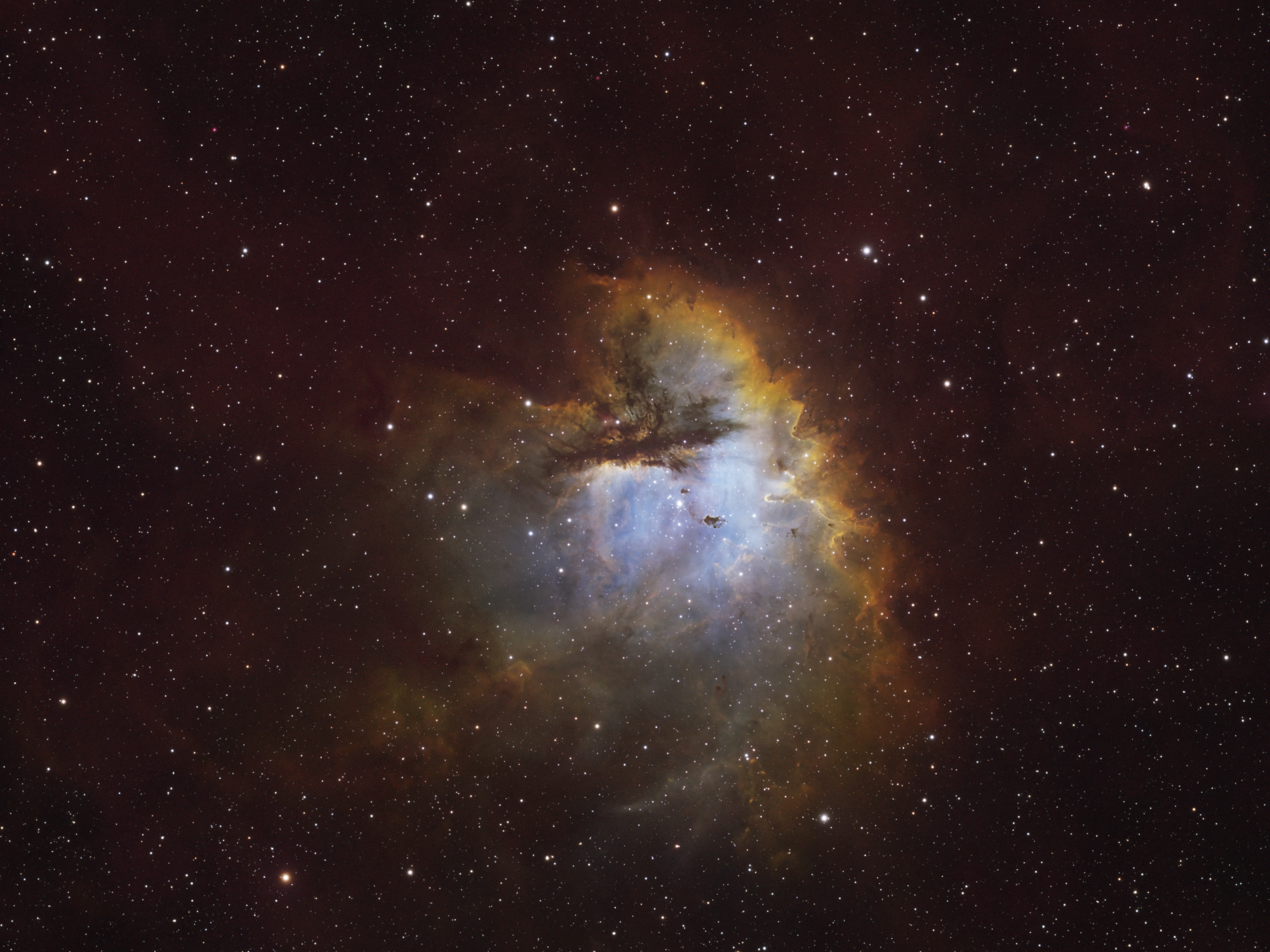

Happily, autumn has arrived in the Colorado Rockies, bringing with it more frequent clear skies. I haven’t had a stretch of clear skies since May, and I was starting to wonder if I’d remember how to shoot the night sky again once the opportunity presents itself. Thankfully, we had two clear nights in October, right after the new moon. My original intent was to use my Sky-Watcher Esprit 100ED f/5.5 refractor to shoot the Rotten Fish Nebula (LDN 1251, a dark nebula). But I discovered that it wouldn’t clear the trees until later than I expected, so I changed targets on the fly and selected the Pacman Nebula (NGC 281).
The Pacman Nebula is a great target for me this time of the year because I can shoot it from dusk until dawn. It’s location in the constellation Cassiopeia makes it circumpolar for me at my latitude of 39 degrees, and this time of the year it transits at about midnight. All I need is a clear, dark night and I’m in business. It’s a great narrowband target, too and heaven knows I love me some good narrowband shooting.
The Pacman is also a decent-sized target for my 100-mm refractor, which I’ve been itching to use again after a couple years of it sitting idle. Most of my imaging happens in the winter, and our habit of going south in the RV during the winter months meant that the 100-mm refractor was left at home in favor of my smaller 80-mm. This year we’re staying put in Colorado and I’m looking forward to having all my gear available for imaging.
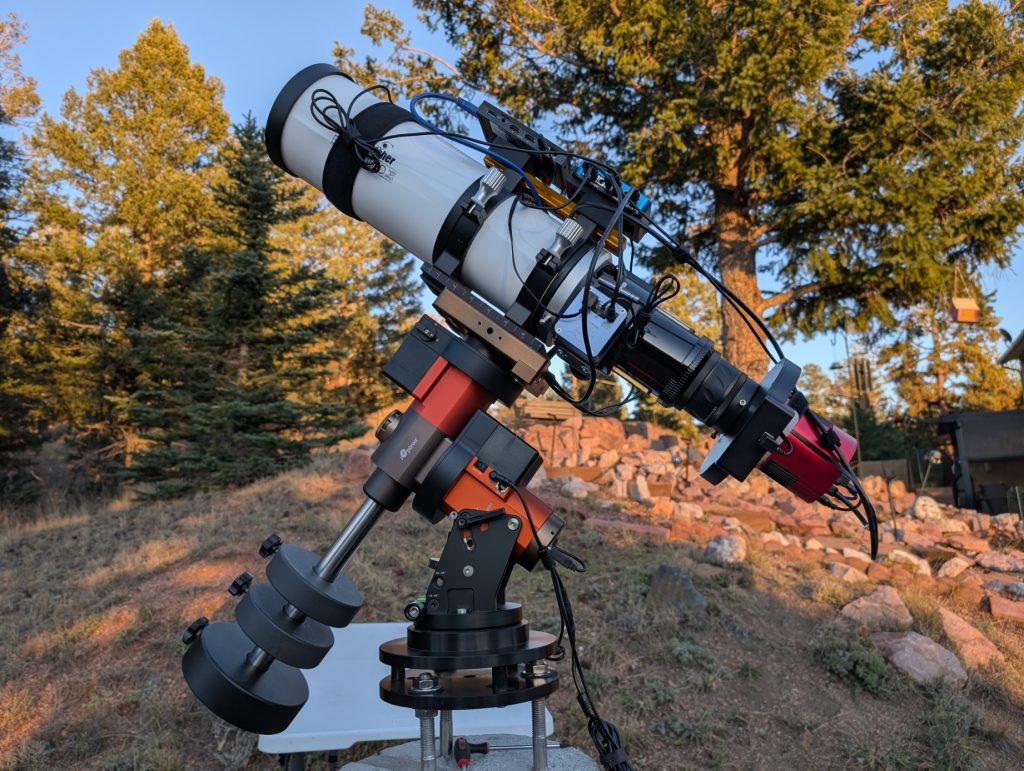
The 100-mm refractor was the first telescope I purchased for astrophotography and it has proven itself as a reliable performer. I generally pair my ZWO ASI2600MM Pro camera with my refractors because their wide field of view is capable of filling its APS-C-sized sensor. This spring I configured the Esprit 100ED with a top rail that holds a Pegasus Pocket Powerbox and a Mele Quieter 3Q mini PC. I still use the iOptron GEM45 mount on the concrete pier, which is a very stable configuration. I like the GEM45 because it has some cable management features that make it easy to get cables through from the bottom of the mount up to the saddle, avoiding the potential for cable snags and whatnot. And the GEM45 is just a good performer. While shooting the Pacman Nebula, PHD2 reported guiding errors that averaged around 0.5 arc seconds, and I get nice round stars.
I was able to image the Pacman for two nights. The first night I shot both narrowband (H-alpha, S-II, O-III) and a bit of RGB to get natural looking stars. The second night I shot only narrowband (you don’t need a ton of data to get decent stars). I do my processing in PixInsight. For narrowband, I generally use the techniques in a 6-part video tutorial for narrowband processing on YouTube created by PixInsight. In particular, I use the methods presented in the first two videos for color calibration to get the pleasing colors of the Hubble palette. Here’s the first video in the series:
Later in the series they go over methods for correcting the magenta stars you end up with, but instead I use StarXTerminator to extract the stars from the narrowband image before doing color correction, and then later add the RGB stars to the narrowband image using PixelMath.
The data I capture for the Pacman revealed quite a bit of nebulosity surrounding the main body of the nebula that I hadn’t uncovered in previous attempts. More time on target than in the past might have uncovered the additional detail. This time around I ended up with 13 hours and 44 minutes of usable data. I would have shot another night or two, but the clouds refused to cooperate.
If you’re interested you can view additional equipment, capture, and processing details on my Astrobin page:

lots of great structure, did you use any sharpening in your workflow?
I did use BlurXTerminator. I try to use that judiciously. 🙂