
I confess that when I first started shooting astrophotography I didn’t even bother with flats and darks. I found them confusing and inconvenient, and the imaging software I used at the time didn’t make it easy. As I got a little smarter, and when I finally got a dedicated temperature-controlled astro camera, I shot a library of darks and I experimented with several methods for shooting flats. At first, my go-to for flats was to press the front of the telescope against an LED monitor displaying a white screen, and I used the N.I.N.A. flat wizard to take the exposures. That worked well enough, but it was inconvenient because I had to do it on the workbench and not on the mount.
I also tried using my Samsung and iPad tablets, placing them on top of my scope as it pointed straight up, which worked okay as long as I was shooting with a scope smaller than their screens. But it was trial-and-error to get the screen brightness where it needed to be. At the same time I experimented with shooting sky flats. I finally settled on a scheme that works pretty well for me, and it involves two high-tech components: an embroidery hoop and a white T-shirt.
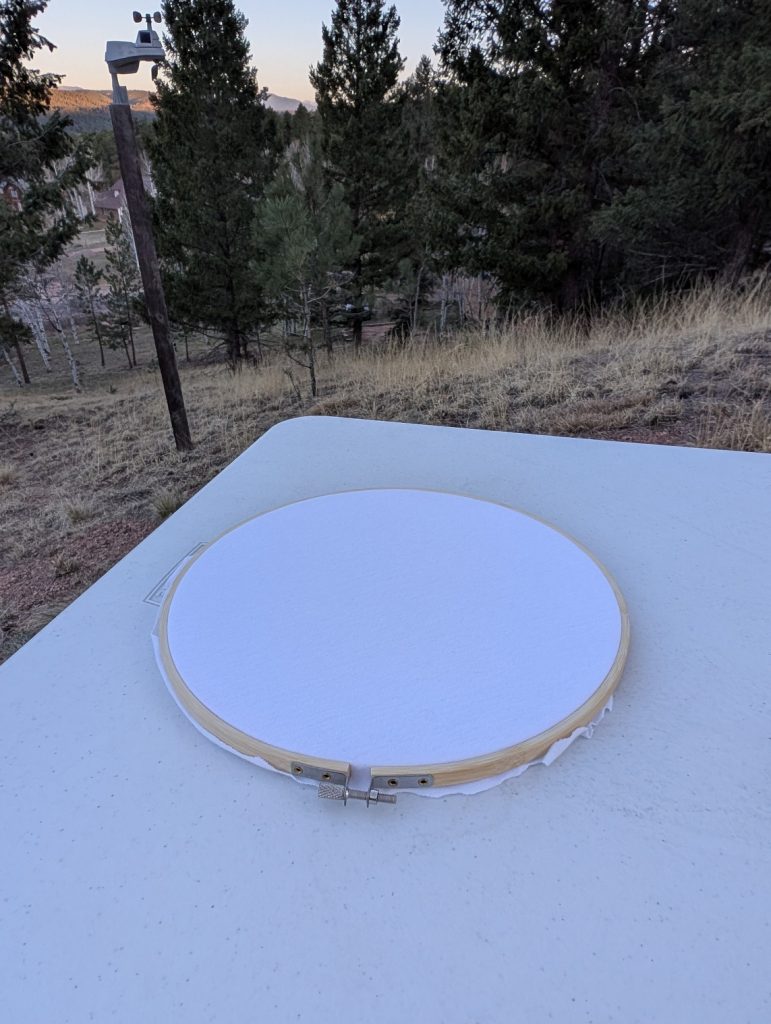
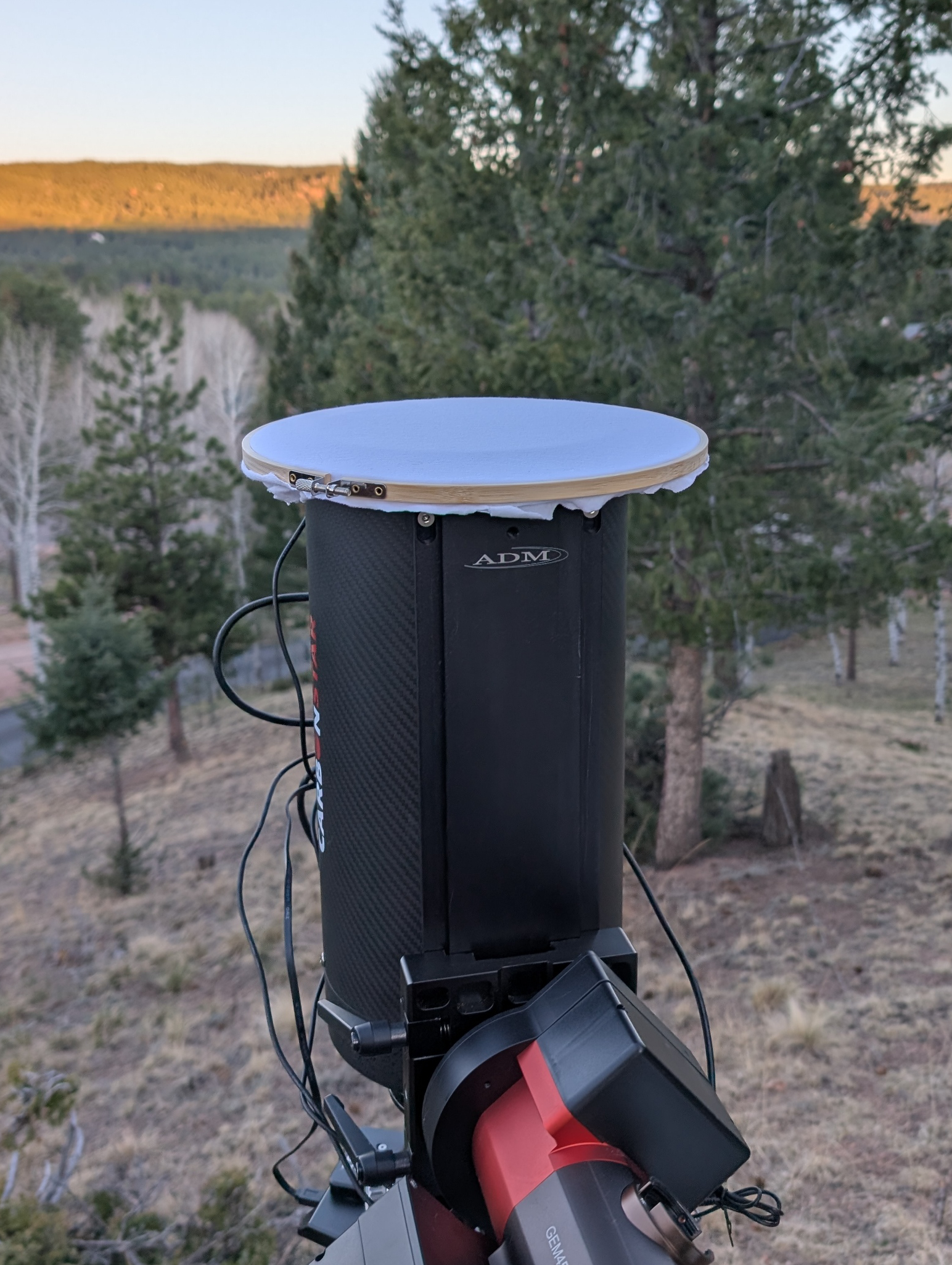
Specifically, two layers of a plain white T-shirt captured in an appropriately-sized embroidery hoop. From experience, I know that I can shoot flats at about sunrise after a night’s imaging run, and the flats will have the exposure lengths that I want. For L, R, G, and B filters, I generally get something between 0.1 seconds and 1 second, and for narrowband filters I get around 5 to 10 seconds. (It’s worth noting that my scope is not in direct sunlight when I shoot flats.)
One interesting thing about shooting the narrowband flats is that the sky actually gets noticeably brighter from the first flat to the last flat for each filter. If you’re shooting with N.I.N.A.’s flat wizard, you can see the histogram moving to the right with successive exposures. For that reason, I have the flat wizard choose an exposure time that puts the histogram at about 40% of max. By the time the last flat is taken, the histogram will have moved to about 50%.
This method has been very reliable and repeatable for me, but it does have the drawback of having to be up before sunrise. In the winter that’s not such a big deal, but it starts to get pretty early in spring and summer. One could perhaps add another layer of T-shirt if needed, but even if you shoot your flats well after sunrise it’s probably best if your scope is in the shade while you shoot them.
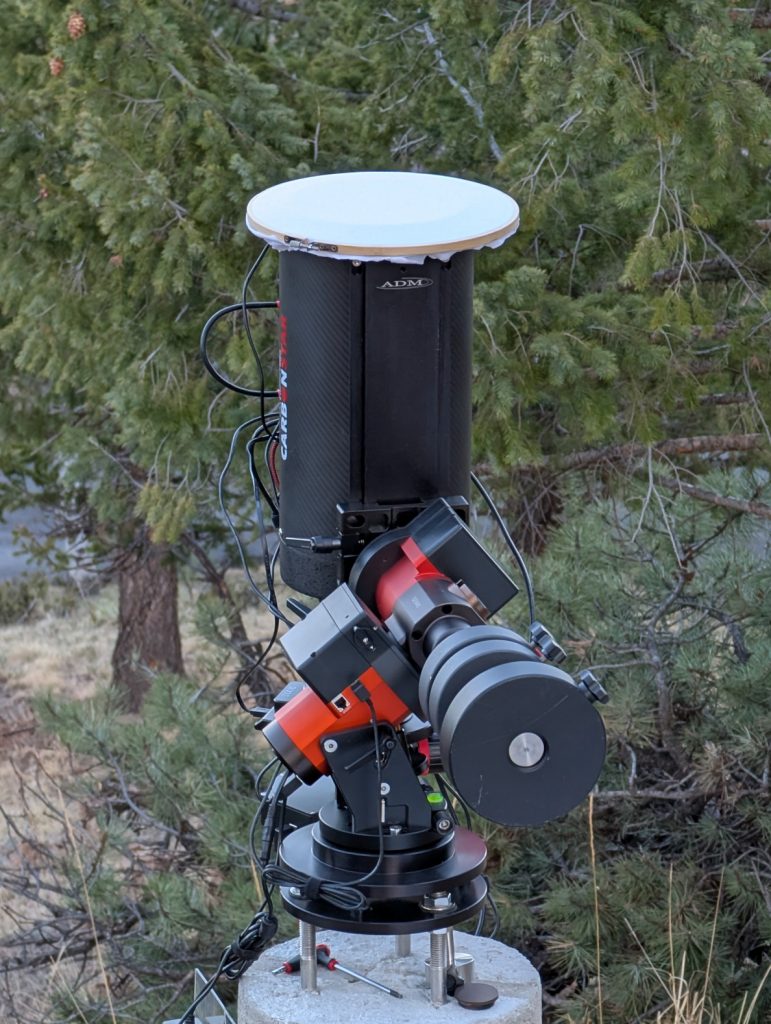
These days I mostly try to shoot the same target for multiple nights, and I shoot a set of flats in the morning after each night of imaging. I do my preprocessing with PixInsight’s Weighted Batch Preprocessing (WPBB) script, and if I set things up right the script will calibrate each night’s lights with the corresponding flats from the following morning. I plan to cover how to do that as part of an upcoming post on data management and organization.
Despite the ease of shooting flats this way, I admit I’m still interested in some of the motorized flat panels that move into position for flats and to act as a retractable cover for the scope. The Pegasus Astro FlatMaster Neo and the motorized flat panels from Deep Sky Dad are two that I know of. Because these types of panels use pulse-width modulation to control their brightness, they can result in uneven illumination, especially for shorter exposures. The reviews are sort of mixed because of that, so I’ve been hesitant to give them a try. Still, if they worked well, it would be hugely convenient to be able to shoot flats whenever I wanted during an imaging run, and to have a cover that automatically deploys when shooting is finished. On the other hand, I have four different scopes that I shoot with, and buying four of these things would be hugely expensive.