How long should my subexposures be? I’m not sure how many of us put a ton of thought into this. I myself have some rules of thumb that seem to work reasonably well for me. I’ve done a little reading on the subject, though and, basically, the answer is, “long enough, but not too long.” Not helpful? Thankfully, there are better explanations.
Before we get into this any farther, I know of at least a couple sources that discuss this topic in a clear and detailed manner. First, Charles Bracken’s book, The Deep-Sky Imaging Primer, belongs in the library of every astrophotographer. Bracken starts his book by explaining modern astro camera sensors and expounding on the different types of noise encountered when using them. We’ll be discussing those in a bit.
Second, you may have run into a YouTube video recording of a presentation by Robin Glover (the author of the SharpCap software) explaining the mathematics of astrophotography as well as covering the topic of subexposure length. Here’s the video–it’s worth an hour of your time.
A Brief Discussion of Noise
(Disclaimer: I’m regurgitating and summarizing what I’ve learned from other sources. If you want a more complete discussion, refer to the two sources I recommended above.)
There are two types of noise that arise in astrophotography. Read noise is uncertainty introduced by the process of reading the pixel levels in the sensor. Read noise shows up in every image captured by a sensor. In normal photography, where there is plenty of light even in very short exposures, read noise is insignificant compared to the signal from the photons we capture. There’s no guarantee that this will be true in our astro subexposures, however, because of the low light levels we work with.
Shot noise, on the other hand, is the uncertainty associated with the photons we collect during our subexposures. This noise appears as randomness by which photons from our target arrive at our sensor–you may recall that the uncertainty in a pixel count is the square root of the count. Shot noise also manifests itself as pixel counts due to heat in the sensor (the reason why we cool our astro cameras). Shot noise is the reason we take many hours worth of subexposures–the more light we capture from our target, the greater becomes the signal to noise ratio, minimizing the noise in our image after we integrate all our subs.
To summarize: we choose our subexposure length so that it makes read noise insignificant, and we choose the number of subexposures to make the shot noise insignificant.
Practical Application
So how long is long enough for a subexposure? Robin Glover’s presentation above gives some math that can be used to estimate the minimum exposure length, but we can also examine the histograms from our subs directly to determine whether we’ve captured enough signal to render the read noise insignificant. Deep Sky Detail has created an easy-to-use tool that does exactly that, and describes it in this recently-released video:
Deep Sky Detail’s tool overlays and displays the histograms from a bias frame or short dark frame along with a light frame (see the leading image for this post). It also makes some calculations to estimate the minimum exposure time (a couple different ways), based on how much you want the signal to swamp the read noise (the swamp factor). The estimates really apply only to the target being shot and the setup used to shoot it. But it would be easy enough to run a few subs through the tool at the beginning of an imaging session to confirm your subs are long enough, if you wanted.
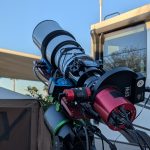
I thought it might be interesting to try the tool for myself and see what it tells me, so I chose two images I’ve taken recently. I shot both M81 and NGC2403 through a 6″ f/9 RC in LRGB using a ZWO ASI533MM Pro camera.
M81
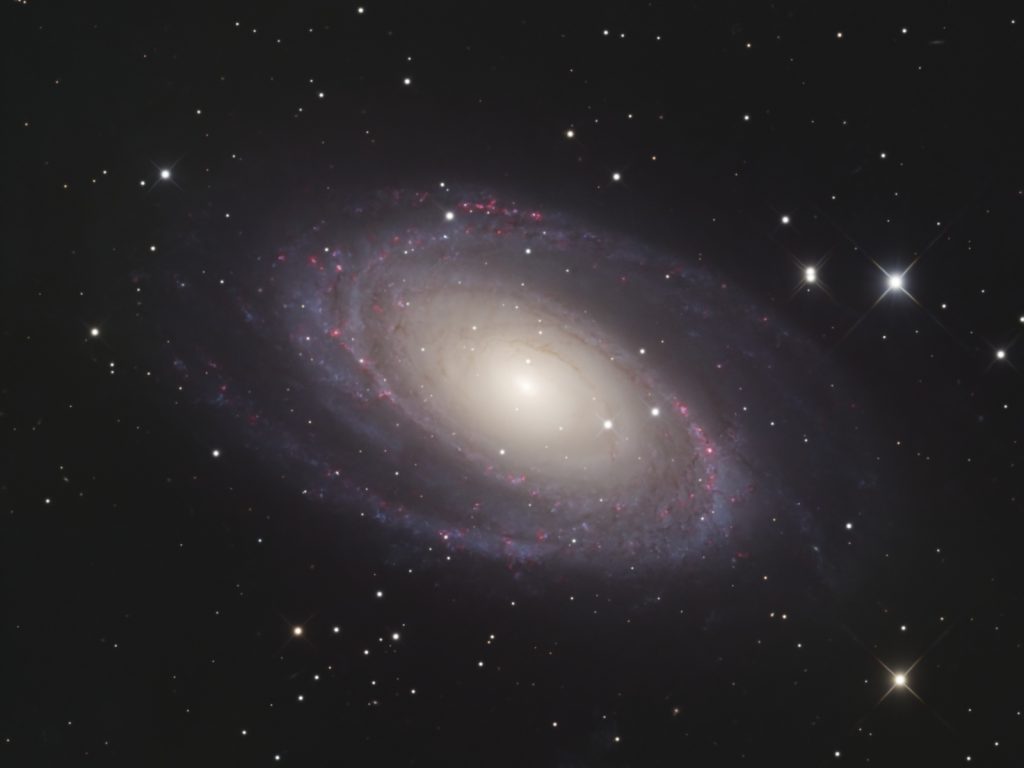
Bode’s Galaxy is a really nice target for longer focal lengths. For this target my subs were 300 seconds for each filter. The tool reported that my minimum exposure times for the L, R, G, and B filters were 82, 279, 263, and 288 seconds, respectively, to achieve a swamp factor of 10 (meaning the read noise histogram and the signal histogram are separated by 10 standard deviations of the read noise). So, it seems my 300-second subs are adequate.
NGC2403
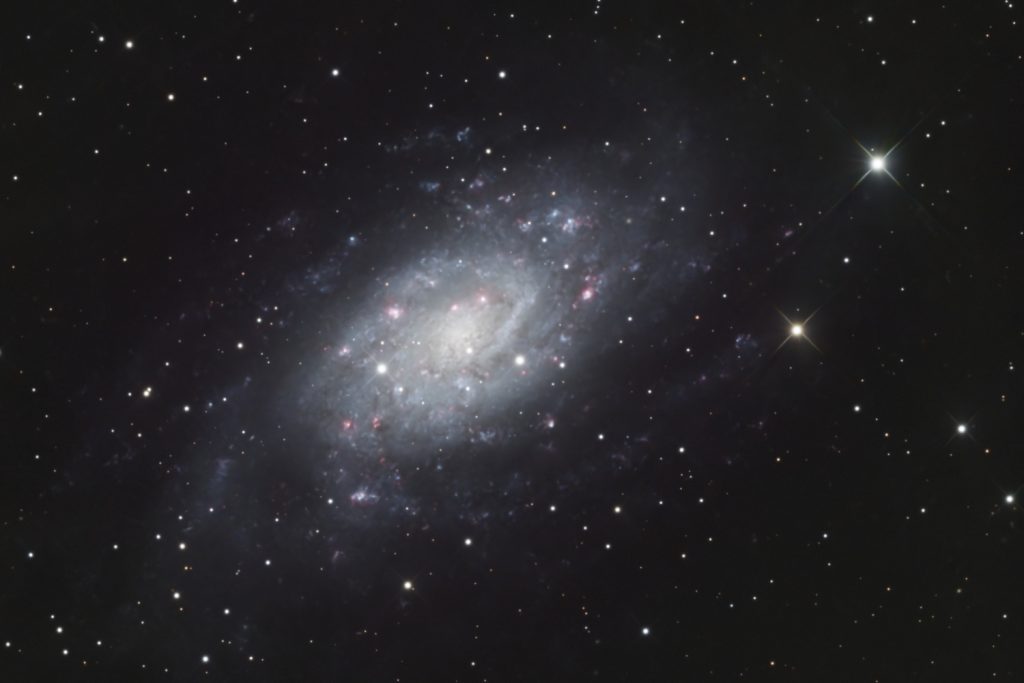
NGC2403 is a little bit more challenging to capture than M81, yet I still shot 300-second subs in LRGB. For a swamp factor of 10 like before, the tool suggested subexposure lengths of 71, 191, 261, and 319 seconds for filters L, R, G, and B, respectively. Once again, my 300-second subs seem to be okay.
So, for this fairly long focal length, would I change my approach? Maybe–it might be worth shooting for eight or ten minutes instead of five, assuming my tracking and guiding is good enough to support that (which it is). But I seem to be okay at five minutes. Five-minute subs should be more than adequate for shorter focal lengths, as well.
It’s worth noting that I tried the tool on some narrowband subs. Curiously, even with 10-minute subs, the tool was recommending subexposure lengths of an order of magnitude (or more) longer in order to achieve a swamp factor of 10. Given that I feel like I get decent results with 10-minute subs, I find these recommendations a bit puzzling. I’ll have to dig a little deeper.
Other Considerations
Deep Sky Detail’s tool seems like a good starting point for choosing subexposure length, but the tool is simply recommending a minimum exposure. Is that the best choice? Once you achieve your goal of swamping the read noise, there is little benefit to exposing longer, but there is also little penalty. Personally, if a 30-second exposure is sufficient to swamp the read noise, I’m still likely to shoot for three or five minutes simply because I would rather have a hundred 300-second subs than a thousand 30-second subs. Fewer subs takes up less storage and processes faster.
By that logic, would ten 3000-second subs be even better? Probably not. With such a lengthy exposure time, I run the risk of saturating pixels and losing information. Plus, if I have to discard a sub for some reason, the cost is higher for a longer sub because it represents a larger percentage of my total time on target.
Given that you can determine the minimum amount of time to expose, the choice of exposure time boils down to a compromise between what is the most convenient and what is the least risky. I choose from a fixed list of exposure times for which I’ve generated dark libraries, just to keep things simple. My list is 1, 2, 3, 5, 6, 8, 10, 15, and 20 minutes. One of those is going to work for pretty-much any target. I’ll only go above 10 minutes if I feel I have to, mainly for narrowband.